Market API
Outcome
By the end of this page you can list an asset for Kei, accept somebody else's listing atomically, cancel your own, and read a price off settled blocks — with no listing table, no matching engine, and no server.
An offer is a swap_offer block (SPEC §9.3). sell() writes the block that locks the seller's own asset, accept() writes one block that moves both legs or neither, and cancel() writes the block that gives the asset back. Everything you read here is read from account chains.
| Concern | Authority |
|---|---|
| Offer terms and locked asset | The seller's signed swap_offer block. |
| Settlement | One buyer-signed swap_accept; both legs move or neither does. |
| Cancellation | The seller's swap_cancel; only the author can release the lock. |
| Which seller accounts to inspect | Your app or registry. Kei ships no global indexer. |
| Matching, curves, automated pricing | Not part of this API. |
Run the smallest complete market
The playground below creates two wallets on Kei.mock(), mints a unique item, lists it for 5 Kei, discovers the listing from the seller's account, accepts it, and asserts ownership, balance, settled state, and median price.
bun install --frozen-lockfile
bun run docs/playgrounds/market.ts
# {"kind":"market","offer":"accepted","price":5,"buyerOwnsItem":true}It is the checked-in file the command and docs-playground regression test both execute, not a shortened version maintained separately from its proof.
import { strict as assert } from 'node:assert'

import { Kei, randomSeed } from 'kei-transaction'

const node = await Kei.mock()
const game = await Kei.server({ seed: 'C'.repeat(64), node })
await game.faucet(20_000)

const seller = await Kei.start({ node, seed: randomSeed(), autoCancelExpired: false })
const buyer = await Kei.start({ node, seed: randomSeed(), autoCancelExpired: false })
await Promise.all([game.send(seller.address, 2_000), game.send(buyer.address, 2_000)])
await Promise.all([seller.sync(), buyer.sync()])

const sword = await game.items.create({ name: 'Sword of Testing' })
await game.items.mint(sword.id, seller.address)
await seller.sync()

const offer = await seller.market.sell({ asset: sword, price: 5 })
assert.equal(await seller.items.owner(sword.id), null) // The ledger locks it.

const [listing] = await buyer.market.offers({ from: seller.address })
assert.equal(listing?.hash, offer.hash)

const settlement = await buyer.market.accept(offer)
assert.equal(await buyer.items.owner(sword.id), buyer.address)
assert.equal(await buyer.balance(), 1_995)
assert.equal(await seller.market.medianPrice(sword), 5)
const settled = await seller.market.get(offer.hash)
assert.equal(settled?.state, 'accepted')

console.log(
  JSON.stringify({
    kind: 'market',
    offer: settled?.state,
    price: settlement.price,
    buyerOwnsItem: true,
  }),
)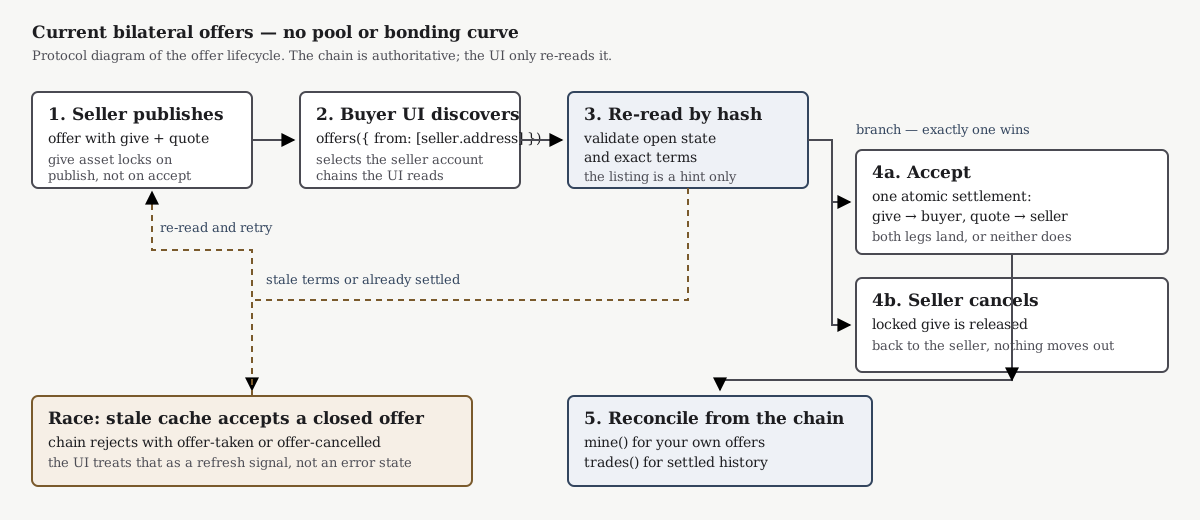
This is a protocol diagram, not a product screenshot. The running Carpet Markets demo puts a deliberately incomplete interface around this flow on a no-value mock chain; the diagram and playground show the ledger behavior the interface is meant to expose.
Before you begin
bun add kei-transaction # or npm / pnpm / yarn@keicoin/market ships separately for bundle size, not as a puzzle to solve — install kei-transaction unless you are counting bytes.
Every wallet from Kei.start() already exposes the market:
import { Kei, randomSeed } from 'kei-transaction'

const node = await Kei.mock()
const alice = await Kei.start({ node, seed: randomSeed() })

alice.market // MarketApiIf you are wiring a client yourself, the package's own entry point is:
import { createMarket } from '@keicoin/market'
import type {
  MarketApi,
  Offer,
  Settlement,
  Trade,
  PriceSummary,
  Series,
  Candle,
  Coverage,
  Covered,
} from '@keicoin/market'

const market = createMarket(client, {
  autoCancelExpired: true,   // default
  sweepInterval: 30_000,     // ms, default
  now: Date.now,             // replaceable so a test needs no timers
})Amounts across this API are plain decimal numbers (SPEC §6.1) — raw units and asset ids belong to the node, not to the developer pricing a sword.
Open the market
createMarket(client, options?) returns a MarketApi. The background expiry sweep is what makes close() matter:
market.close() // stops the sweep; Kei.close() calls this for youCreate offers
Three writers, one shape underneath. sell and bid are offer with Kei on one side.
sell(options: SellOptions): Promise<Offer>
bid(options: BidOptions): Promise<Offer>
offer(options: OfferOptions): Promise<Offer>// Seller: locks the item, asks 5 Kei
const listing = await alice.market.sell({ asset: sword, price: 5 })
listing.give.amount // 1
listing.want.symbol // 'KEI'
listing.price // 5 — want per one unit of give
listing.to // null: anyone may accept
// Buyer: the mirror — locks 5 Kei out of this wallet until it settles
await bob.market.bid({ asset: sword, price: 5 })
// Any asset for any asset
await alice.market.offer({
give: { asset: sword, amount: 1 },
want: { asset: coin, amount: 40 },
})asset takes an asset id or anything with an id, so an Item or a token works directly. amount defaults to 1 — the item case.
sell({ amount, price }) takes the total ask, not the price each
The returned Offer.price is per unit, so the two differ by amount. On a coin with a million units, getting this backwards mislists by orders of magnitude.
Reserve a listing for one buyer with to, and give it an advisory expiry with expiresIn (a duration like '7d', '90m', '1ms') or expiresAt (a Date or ms timestamp) — one or the other, never both:
await alice.market.sell({ asset: sword, price: 5, to: bob.address })
await alice.market.sell({ asset: sword, price: 5, expiresIn: '7d' })An offer reserved for your own address is refused before anything locks.
Read and accept
This is the whole of MarketApi in @keicoin/market@0.4.0. Covered<T> is a T[] with a non-enumerable coverage on it, so it destructures, maps and indexes like the array it is:
get(hash: string): Promise<Offer | null>
offers(options: ListOptions): Promise<Covered<Offer>>
mine(options?: MineOptions): Promise<Covered<Offer>>
accept(offer: string | Offer, options?: AcceptOptions): Promise<Settlement>
cancel(offer: string | Offer): Promise<Cancellation>
cancelExpired(): Promise<Cancellation[]>
trades(options?: TradeOptions): Promise<Covered<Trade>>
medianPrice(asset, options?): Promise<number | null>   // a scalar; carries no coverage
price(asset, options?): Promise<PriceSummary | null>   // the same numbers, with coverage
prices(options?): Promise<PriceIndex>                  // every traded asset, out of one walk
book(options: BookOptions): Promise<Book>
series(options): Promise<Series>                       // ordered points, ready to draw
candles(options): Promise<Covered<Candle>>             // the same trades, in OHLCV buckets
reconcile(snapshot, options?): Promise<Reconciliation> // what became of listings you cached
lifeOf(offer: Offer): OfferLife                        // 'live' | 'reserved' | 'stale' | 'taken' | 'cancelled'
close(): voidhistory, ohlc, ticker and chart are not published
Compatibility wrappers under those names are on kei-transaction's master branch and are in no released package. Publication is frozen behind kei-transaction#107, so calling one on an installed wallet is TypeError: not a function. Use series() and candles(), which is what those wrappers wrap. The playground below asserts their absence, so this page stops saying it the moment they ship.
An offer's hash is its id — the swap_offer block's hash. Read it from offers() rather than typing one:
const listings = await bob.market.offers({ from: alice.address })
const settlement = await bob.market.accept(listings[0])
settlement.received.asset   // the sword
settlement.paid.amount      // 5
settlement.price            // 5

// A bare hash works too
await bob.market.accept(listing.hash)accept() is one block, both legs or neither (SPEC §9.2). By the time the promise resolves the wallet has collected both sides, so the item is in the balance.
Cancel returns exactly what was locked, and only the author may write it:
const cancellation = await alice.market.cancel(listing)
cancellation.returned.asset // back in alice's spendable balanceget() reads one offer by hash and returns null for one that never existed. mine() is this wallet's own offers — it includes expired ones by default, because those are exactly the ones you need to see; pass { state: null } for every state.
book() turns one bounded walk of the accounts you name into consistently oriented asks and bids:
const book = await bob.market.book({
  from: [alice.address, bob.address],
  asset: sword,
})

book.asks[0]?.unitPrice // quote units per sword; cheapest ask first
book.bids[0]?.unitPrice // the same units; highest bid first
book.coverage // what the bounded account walk read, missed, or truncatedSince @keicoin/market@0.4.0, best-level selection compares the raw quote/base ratios exactly, including asset decimal scaling. unitPrice and spread remain plain-number display fields, so two different exact prices can display the same number and spread can display as zero. The ordering still uses the exact ledger ratios.
Price history is settled offers, nothing else:
await alice.market.trades()                       // Trade[]; every state === 'accepted'
await alice.market.medianPrice(sword)             // 5, or null if never sold
await alice.market.price(sword)                   // { median, last, low, high, trades, volume }
await alice.market.medianPrice(sword, { window: '7d' })A still-open listing is not a trade: medianPrice() on it is null and trades() is []. trades() and price() default to this wallet's own trades — pass { from } to summarise somebody else's, or a wallet that has never traded reads as a coin with no history.
Read a chart
One trade read feeds both the line and the candles. series() orders the settled trades and hands back the summary over exactly those points; candles() buckets the same trades. The wallets and the ore token below are the ones in the runnable proof at the end of this section:
const series = await buyer.market.series({
  asset: ore,
  from: [alice.address, bob.address],   // omit for this wallet's own trades
  window: '30d',
})

series.points        // oldest first, each { index, price, units, paid, hash, seller, buyer, at, estimated }
series.first         // the oldest price, or null
series.last          // the newest
series.change        // last - first
series.changeRatio   // change / first
series.summary       // { median, last, low, high, trades, volume, coverage }
series.ordering      // { by: 'advisory-time', exact, estimated, note }
series.coverage      // what the walk behind these trades read and missed

const candles = await buyer.market.candles({ asset: ore, every: '1h' })
candles[0]           // { at, every, open, high, low, close, volume, trades }
candles.coverage // the same walk, on the arrayevery is the bucket width — '1h', '15m', '7d', or milliseconds. There is no interval alias in a published package. fill: true emits the empty buckets between trades and is bounded by maxCandles (10,000 by default, 1,000,000 at most), because a dense request is sized by two timestamps rather than by how many trades were read.
For a board pricing many assets at once, prices() groups one walk instead of walking per asset:
const index = await buyer.market.prices()   // Map<AssetId, PriceSummary>, with coverage
index.get(ore.id)?.medianWhat a chart does not tell you
Three things, and none of them is cosmetic.
Coverage is about the accounts you named, not about the market. There is no global order book and no indexer: a walk reads the chains you asked for. coverage.complete: true means every account you named answered — it does not mean you asked about everybody. Reading one seller instead of two returns a complete walk and a strictly smaller history, and the playground below settles three trades and then demonstrates exactly that. coverage.complete: false means some chain did not answer, and the numbers are a floor over what did. medianPrice() is a scalar and cannot carry any of this; use price().median when completeness matters.
Ordering is advisory. That a trade happened, between whom, in what assets and at what price is consensus, and every statistic derived from those numbers is recomputable. When is not: the block-lattice has no clock, so settledAt and seenAt are the node's own first-seen times. Two nodes disagree and a restarted node forgets. series.ordering.exact is false when any point fell back to seenAt, and ordering.estimated counts them. The values inside a candle are exact for the trades in it; which trades are in it is advisory.
Verify a trade against the block, not against a chart. get(hash) re-reads the offer and lifeOf(offer) turns it into the state a view means — live, reserved, stale, taken, cancelled. reconcile(snapshot) does that for a whole cached list. Pass accept(offer, { expect }) with the terms your screen rendered and the offer is checked field by field against the chain immediately before signing, which is what keeps any index a list of where to look rather than an authority (SPEC §9.4).
Run the chart proof
bun install --frozen-lockfile
bun run docs/playgrounds/market-chart.ts
# {"kind":"market-chart","points":3,"prices":[2,3,5],"median":3,"volume":30,"ordering":"advisory-time","candles":1,"coverageComplete":true,"narrowPoints":2,"unpublishedAliases":["history","ohlc","ticker","chart"]}It settles three trades at three prices across two seller accounts, draws them, narrows the walk to one seller to show a complete read of a partial market, and asserts that history, ohlc, ticker and chart are absent from the installed package. The file below is the file that command runs.
/**
 * The chart path, against the published package.
 *
 * A chart is the one market read where the distance between "this ran" and
 * "this is the market" is largest, so this file is written to measure both. It
 * settles three trades at three prices, draws them, and then asks the two
 * questions a renderer has to answer before it puts a line on a screen: which
 * accounts did the walk actually read, and how good is the ordering it used.
 *
 * It also asserts what is *not* here. `history`, `ohlc`, `ticker` and `chart`
 * are compatibility wrappers on `kei-transaction`'s master branch and are not
 * in any published package, because publication is frozen behind
 * kei-transaction#107. A page that names them would be describing a branch. The
 * day they publish, the refusal at the bottom of this file fails and the page
 * that embeds it is the thing to rewrite.
 */

import { strict as assert } from 'node:assert'

import { Kei, randomSeed } from 'kei-transaction'

const node = await Kei.mock()
const game = await Kei.server({ seed: 'F'.repeat(64), node })
await game.faucet(20_000)

const ore = await game.token.issue({ name: 'Ore', symbol: 'ORE', decimals: 0, transfer: 'open' })

const alice = await Kei.start({ node, seed: randomSeed(), autoCancelExpired: false })
const bob = await Kei.start({ node, seed: randomSeed(), autoCancelExpired: false })
const buyer = await Kei.start({ node, seed: randomSeed(), autoCancelExpired: false })

await Promise.all([game.send(alice.address, 100), game.send(bob.address, 100), game.send(buyer.address, 1_000)])
await Promise.all([ore.mint(alice.address, 20), ore.mint(bob.address, 10)])
await Promise.all([alice.sync(), bob.sync(), buyer.sync()])

// Three settled trades at three prices. `price` on a listing is the total ask;
// `Offer.price` comes back per unit, which is what a chart plots.
const cheap = await alice.market.sell({ asset: ore, amount: 10, price: 20 })
assert.equal(cheap.price, 2)
await buyer.market.accept(cheap)

const middle = await alice.market.sell({ asset: ore, amount: 10, price: 30 })
assert.equal(middle.price, 3)
await buyer.market.accept(middle)

const dear = await bob.market.sell({ asset: ore, amount: 10, price: 50 })
assert.equal(dear.price, 5)
await buyer.market.accept(dear)

await Promise.all([alice.sync(), bob.sync(), buyer.sync()])

// `series()` is one trade read, ordered and ready to draw. `trades()` defaults
// to this wallet's own chain, and the buyer was a party to all three.
const series = await buyer.market.series({ asset: ore })
assert.equal(series.points.length, 3)
assert.deepEqual(
  series.points.map((point) => point.price).sort((a, b) => a - b),
  [2, 3, 5],
)

// Ordering is the honest part. There is no clock in consensus, so the only
// order available across two chains is the node's own first-seen time, and the
// series says so in a field rather than in a comment.
assert.equal(series.ordering.by, 'advisory-time')
assert.equal(series.summary?.median, 3)
assert.equal(series.summary?.low, 2)
assert.equal(series.summary?.high, 5)
assert.equal(series.summary?.volume, 30)
assert.equal(series.summary?.trades, 3)

// Candles are the same trades with a bucket around them. The values inside a
// bucket are exact; which trades land in which bucket is advisory.
const candles = await buyer.market.candles({ asset: ore, every: '1d' })
assert.equal(candles.length, 1)
assert.equal(candles[0]?.high, 5)
assert.equal(candles[0]?.low, 2)
assert.equal(candles[0]?.volume, 30)
assert.equal(candles[0]?.trades, 3)

// Coverage answers one question and not the other. It says the accounts this
// walk named answered — never that the accounts it named were the market.
assert.equal(series.coverage?.complete, true)
assert.equal(candles.coverage.complete, true)

// The same asset, read from one seller instead of both: still a complete walk,
// and a strictly smaller history. This is what a partial read looks like when
// nothing failed, and it is why `complete: true` is not "this is the market".
const narrow = await buyer.market.series({ asset: ore, from: alice.address })
assert.equal(narrow.coverage?.complete, true)
assert.equal(narrow.points.length, 2)
assert.equal(narrow.summary?.high, 3)

// `medianPrice()` is a scalar and cannot carry any of that.
assert.equal(await buyer.market.medianPrice(ore), 3)

// Where to verify a trade rather than infer it: the offer block itself.
assert.equal((await buyer.market.get(dear.hash))?.state, 'accepted')
assert.equal(buyer.market.lifeOf((await buyer.market.get(dear.hash))!), 'taken')

// One walk, every traded asset — instead of one walk per asset on a board.
const prices = await buyer.market.prices()
assert.equal(prices.get(ore.id)?.median, 3)

// The compatibility names, which this package does not have. Publication is
// frozen (kei-transaction#107), so a page that documented them would be
// documenting a branch.
const market = buyer.market as unknown as Record<string, unknown>
const unpublished = ['history', 'ohlc', 'ticker', 'chart'].filter(
  (name) => typeof market[name] === 'function',
)
assert.deepEqual(unpublished, [])

console.log(
  JSON.stringify({
    kind: 'market-chart',
    points: series.points.length,
    prices: series.points.map((point) => point.price).sort((a, b) => a - b),
    median: series.summary?.median,
    volume: series.summary?.volume,
    ordering: series.ordering.by,
    candles: candles.length,
    coverageComplete: series.coverage?.complete,
    narrowPoints: narrow.points.length,
    unpublishedAliases: ['history', 'ohlc', 'ticker', 'chart'],
  }),
)State and errors
Offer.state is 'open' | 'accepted' | 'cancelled'. Failures throw KeiError with a stable code:
| Code | When |
|---|---|
insufficient-balance | The wallet does not hold what the offer locks or the accept pays. Names what you hold, what is needed, and how much is locked in your own open offers. |
self-swap | to is your own address — only you could accept, and that moves nothing. |
self-accept | Accepting your own listing. cancel() is what you want. |
offer-taken | Already accepted. An offer settles exactly once. |
offer-cancelled | The author took it back. |
not-the-counterparty | Reserved for another address (SPEC §9.2). |
not-your-offer | Only the author can cancel — nobody else's asset is locked by it. |
no-such-offer | No offer with that hash on this network. |
no-accounts | offers() called without from. |
bad-expiry | expiresIn and expiresAt both passed, or a nonsense timestamp. |
Three properties follow from the design and are worth knowing before you build against it.
Only the offerer locks anything, and it is their own asset. The same sword cannot be listed twice, because after the first offer it is not in the seller's spendable balance to offer again. The most confusing symptom is "where did my sword go?" — the answer is usually an offer this wallet already wrote, and cancel() frees it.
Accept and cancel race for one locked entry, and either can win (SPEC §9.2, conflict 4). Run both and exactly one succeeds; the loser gets a plain KeiError. A lost race is a normal outcome, not a bug, and the asset is never stuck — it is with its new owner or back home.
Expiry is advisory. The chain has no clock, so an expired offer still settles if somebody accepts it. Offer.expired is a hint for the view, never a guarantee. What actually removes a listing is the offerer's own cancel — which the SDK writes in the background by default. Switch that off with autoCancelExpired: false and sweep by hand:
const quiet = await Kei.start({ node, seed: randomSeed(), autoCancelExpired: false })
await quiet.market.cancelExpired() // Cancellation[], only this wallet's owncancelExpired() swallows offer-taken and offer-cancelled on the way through: losing that race is a sale, not a failure.
Network boundary
offers({ from }) and trades({ from }) read a bounded walk of the accounts you name. There is no network-wide listing index (SPEC §9.4): an offer lives on its author's chain, so "every listing on the network" is an indexer, and Kei moves and records assets rather than running a matching engine. Calling offers() without from throws no-accounts on purpose.
Somebody in your app has to remember which accounts have touched an asset. In Carpet Markets that is the registry — it never holds a coin, never quotes a price, and cannot move a balance; it issues, and it is the list of who to read. A reader with the same list gets the same answer without asking it anything.
Everything above runs identically against Kei.mock() in-process and against a node over HTTP — clients that share nothing but a URL list, settle, and read price history the same way. The lock is the ledger's, not the SDK's: over the wire, offering seven units when six remain is still refused.
There is no testnet dependency in this quickstart and nothing in the mock holds value. A persistent public network is a different deployment decision from the mock — a launchpad anybody can mint on belongs on a chain nobody can mistake for one that matters.
The current model
This is the peer-to-peer offer book as it exists today: every price is the last thing two people agreed on, read off settled swap_accept blocks. There is no pool, no bonding curve, and no automated market maker in @keicoin/market — an asset nobody has traded has no price, and medianPrice() returns null rather than quoting one. For how an offer moves through that model end to end, see the loop.
Test it
The market runs end to end against the mock ledger, which enforces the self-locking rule and the accept-vs-cancel race the same way a real node will:
import { beforeEach, expect, test } from 'bun:test'
import { Kei, randomSeed } from 'kei-transaction'

test('a sale settles atomically, and the price is readable off the chain', async () => {
  const node = await Kei.mock()
  const game = await Kei.server({ seed: 'C'.repeat(64), node })
  await game.faucet(20_000)

  const alice = await Kei.start({ node, seed: randomSeed() })
  const bob = await Kei.start({ node, seed: randomSeed() })
  await Promise.all([game.send(alice.address, 2_000), game.send(bob.address, 2_000)])
  await Promise.all([alice.sync(), bob.sync()])

  const sword = await game.items.create({ name: 'Sword of Testing' })
  await game.items.mint(sword.id, alice.address)
  await alice.sync()

  const offer = await alice.market.sell({ asset: sword, price: 5 })
  expect(await alice.items.owner(sword.id)).toBeNull()   // genuinely locked

  await bob.market.accept(offer)
  expect(await bob.items.owner(sword.id)).toBe(bob.address)
  expect(await bob.balance()).toBe(2_000 - 5)
  expect(await alice.market.medianPrice(sword)).toBe(5)
})Minted assets are a receivable, not a balance — they are owed until the recipient's wallet signs for them, so sync() before selling or the listing fails with "balance is 0".
To assert the race directly:
const results = await Promise.allSettled([bob.market.accept(offer), alice.market.cancel(offer)])
expect(results.filter((r) => r.status === 'fulfilled')).toHaveLength(1)
expect(results.filter((r) => r.status === 'rejected')).toHaveLength(1)Next steps
- Offer lifecycle — one offer end to end: publish, discover, accept or cancel, and reconcile.
- Future pool design (proposal) — an unbuilt proposal for pooled, quoted trading, and the protocol work it would take.
- Carpet Markets — the worked demo this API drives, and what the server is still for.
- World of Wonder — the same rules inside a real game.
- Tokens reference —
transfer,swap, and what issuance costs.